Introduction
One often assumes that decaffeinated coffee lacks the depth and crema of its caffeinated counterpart. In reality, a well‑executed decaf espresso can deliver the same richness, balance, and aromatic complexity when the correct technique and tools are employed. This guide explains the essential steps required to produce a perfect decaf espresso on a compact espresso machine, while highlighting why certain products enhance each stage of the process. Readers will acquire a systematic approach that can be applied with or without the recommended equipment, ensuring consistent results in any home kitchen.
Understanding the science behind extraction, temperature stability, and pressure control is vital for success. The guide also addresses common pitfalls, provides professional‑grade troubleshooting, and offers practical advice for maintaining the machine over the long term. By the end of the article, one will be equipped to enjoy café‑quality decaf espresso without leaving the house.
What You'll Need
- High‑quality decaf espresso beans, freshly roasted and stored in an airtight container.
- Conical burr grinder capable of producing a fine, consistent grind.
- Digital scale for precise dosing (15‑18 g per shot).
- Tamper with a flat surface to achieve even compression.
- Compact espresso machine – recommended options are the Gaggia E24 Classic Espresso Machine and the AMZCHEF 20‑Bar Espresso Machine.
- Milk frothing pitcher (optional) and a thermometer for milk temperature.
1. Prepare the Machine
The first step is to ensure the espresso machine reaches the optimal brewing temperature, typically between 90 °C and 96 °C (194 °F‑205 °F). The Gaggia E24 Classic Espresso Machine features a commercial‑grade boiler and a three‑way solenoid valve that maintains temperature stability and prevents excess water from dripping after extraction. Its 9‑bar pump delivers consistent pressure, which is essential for extracting the full flavor profile of decaf beans.
Begin by filling the 41 oz water reservoir with filtered water to avoid mineral buildup. Power on the machine and allow the pre‑heat cycle to complete; the built‑in indicator will signal when the boiler is ready. This warm‑up period typically lasts three to five minutes, during which the machine stabilises its internal pressure and temperature, creating a reliable foundation for the subsequent steps.
2. Select and Grind Decaf Beans
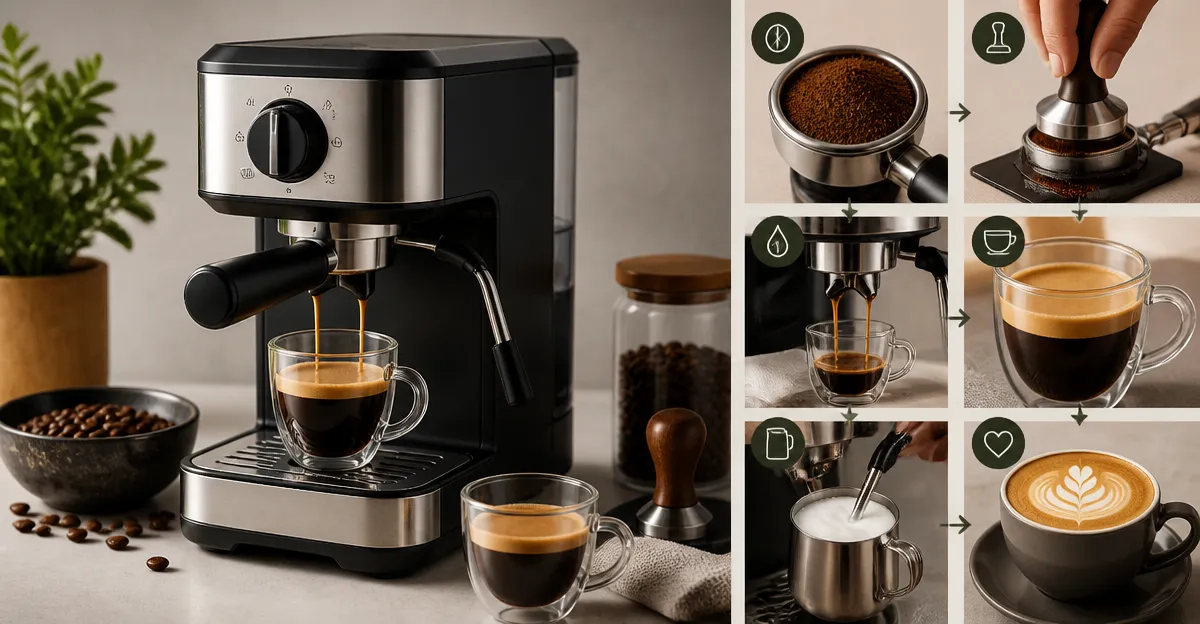
Decaf beans differ from regular beans in that the caffeine removal process can slightly alter the bean's cellular structure, making a precise grind even more critical. Use a burr grinder rather than a blade grinder to achieve uniform particle size, which promotes even water flow during extraction. Aim for a grind that resembles fine sand; on a digital scale, dose 16 g of coffee for a standard double shot.
After grinding, allow the grounds to rest for thirty seconds. This brief pause lets any static charge dissipate, reducing clumping and ensuring a level distribution in the portafilter. If the grind appears too coarse, adjust the grinder one click finer; if it feels powdery, adjust one click coarser. Consistency at this stage directly influences crema formation and overall flavor balance.
3. Dose, Distribute, and Tamp
Place the freshly ground coffee into the 58 mm commercial portafilter that ships with the Gaggia E24 Classic Espresso Machine. The portafilter’s stainless‑steel construction ensures durability and even heat transfer during extraction. Use a digital scale to verify the dose, then perform a gentle distribution stroke to level the grounds without creating air pockets.
Next, tamp the coffee with a calibrated tamper applying approximately 30 lb of pressure. The goal is to create a uniformly compressed puck that offers consistent resistance to the water flow. A level tamp prevents channeling, a condition where water finds the path of least resistance, resulting in under‑extracted, weak espresso. After tamping, inspect the surface for any cracks; a smooth, glossy surface indicates a proper tamp.
4. Pull the Decaf Espresso Shot
Insert the portafilter into the brew head and initiate the extraction. The Gaggia E24 Classic Espresso Machine delivers a stable 9‑bar pressure, which is ideal for extracting the soluble compounds in decaf beans within the optimal time window of 25‑30 seconds for a double shot (approximately 60 ml). Observe the flow: it should begin as a thin, steady stream that gradually thickens into a honey‑colored crema.
If the extraction time is shorter than 25 seconds, the grind may be too coarse or the tamp insufficiently firm. Conversely, a time exceeding 30 seconds suggests an overly fine grind or excessive tamp pressure. Adjust the variables accordingly and repeat the process until the desired extraction profile is achieved. The resulting espresso should exhibit a balanced acidity, subtle sweetness, and a lingering aftertaste despite the absence of caffeine.
5. Froth Milk (Optional)
For those who enjoy a latte or cappuccino, milk frothing adds texture and visual appeal. The AMZCHEF 20‑Bar Espresso Machine includes an adjustable steam wand that produces micro‑foam suitable for latte art. Its 20‑bar pressure exceeds the minimum required for professional‑grade milk texture, allowing one to create a velvety foam even without extensive barista training.
Fill a stainless‑steel pitcher with cold whole milk to a level no higher than one‑third of its capacity. Submerge the steam wand tip just below the milk surface and activate the steam function. As the milk expands, lower the pitcher gradually to maintain the tip near the surface, producing a gentle hissing sound that indicates air incorporation. Once the milk reaches 65 °C (149 °F), turn off the steam and tap the pitcher to eliminate large bubbles. The resulting micro‑foam should have a glossy, porcelain‑like appearance, ideal for pouring over the decaf espresso.
6. Clean and Maintain the Machine
Proper maintenance preserves temperature stability and prevents scale buildup, which can impair extraction quality. After each use, purge the group head by running a short blast of water through the portafilter. The three‑way solenoid valve on the Gaggia E24 Classic Espresso Machine automatically releases excess water, keeping the brew chamber dry and reducing the risk of mold.
Perform a weekly backflush using a blind filter and a cleaning solution designed for espresso machines. This process clears coffee oils and residue from the internal pathways. For the AMZCHEF 20‑Bar Espresso Machine, engage the self‑cleaning mode via the LED touchscreen; the machine circulates hot water to dissolve mineral deposits, simplifying routine upkeep. Descaling every three months with a citric‑based solution prolongs the lifespan of the boiler and maintains consistent pressure.
Tips & Pro Tips
- Use filtered water with a mineral content of 150‑200 ppm to optimise extraction and minimise scale formation.
- Store decaf beans in an opaque, airtight container away from heat and light to preserve aromatic oils.
- When frothing milk, incorporate a small amount of air for the first two seconds, then focus on stretching the milk to achieve a silky texture.
- Record grind size, dose, and extraction time in a notebook; subtle adjustments become easier when trends are documented.
- If crema appears thin, consider increasing the brew temperature by a degree or two, as decaf beans sometimes benefit from slightly higher heat.
Troubleshooting
Problem: Espresso is watery and lacks crema.
Solution: Verify that the grind is fine enough and that the tamp pressure is uniform. Check that the machine has reached full temperature; a cold boiler will produce under‑extracted coffee.
Problem: Milk foam is large‑bubbled and unstable.
Solution: Reduce the steam wand tip depth and ensure the wand tip is clean. Use cold milk and avoid overheating; temperature above 70 °C (158 °F) breaks down protein structures, leading to coarse bubbles.
Conclusion
Creating perfect decaf espresso on a compact machine is entirely achievable when one respects the principles of temperature control, pressure stability, and precise dosing. By following the six steps outlined above, employing the recommended Gaggia E24 Classic Espresso Machine for extraction and the AMZCHEF 20‑Bar Espresso Machine for milk frothing, one can enjoy café‑quality decaf drinks at home. Consistent practice, diligent maintenance, and attention to detail will ensure that each cup delivers the full richness expected from a true espresso, even without caffeine.
Products Mentioned in This Guide
Frequently Asked Questions
How can I achieve a rich crema on decaf espresso using a compact espresso machine?
Use freshly roasted decaf beans, grind them to a fine, consistent size, and brew at 90‑94°C with 9‑10 bar pressure for 25‑30 seconds.
Why is a conical burr grinder important for decaf espresso?
A conical burr grinder provides uniform particle size, preventing channeling and ensuring even extraction of the subtle flavors in decaf beans.
What temperature stability issues affect decaf espresso extraction?
Decaf beans are more sensitive to temperature fluctuations; maintain a stable brew temperature within the 90‑94°C range to avoid under‑ or over‑extraction.
What are common pitfalls when pulling decaf espresso on a small machine?
Typical errors include using stale beans, grinding too coarse, incorrect tamp pressure, and not allowing the machine to fully pre‑heat.
How should I maintain my compact espresso machine for consistent decaf shots?
Regularly clean the portafilter, group head, and steam wand, descale according to the manufacturer’s schedule, and replace the gasket every 6‑12 months.