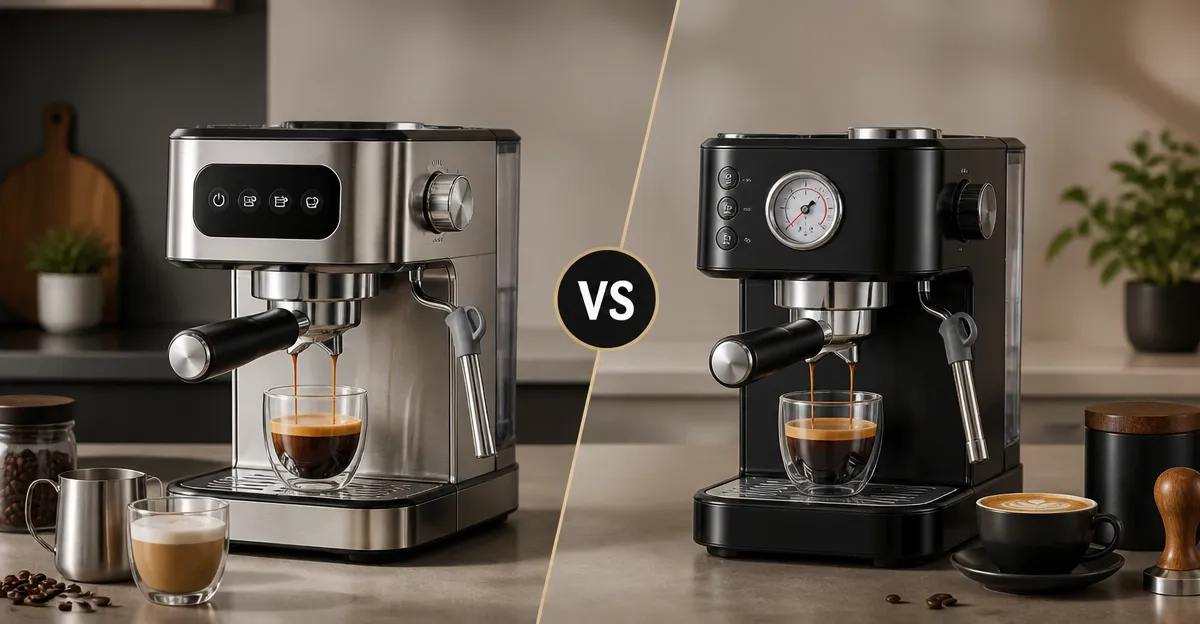
Introduction
Choosing a home espresso machine often feels like balancing cost, convenience, and coffee quality. This article compares two popular Amazon listings: the CHULUX Bafè‑Pro Espresso Machine and the SHARDOR 20 Bar Espresso Machine. Both promise café‑grade results, yet they differ in power, user interface, and ancillary features. Understanding these differences helps one decide which model aligns with personal brewing habits and kitchen space.
Individual Product Overviews
CHULUX Bafè‑Pro Espresso Machine
The CHULUX Bafè‑Pro targets pod users, accepting Nespresso Original capsules and delivering a 20‑Bar Italian pump powered by a 1400 W heating element. At $95.99 it positions itself as an affordable, compact solution, with a 24‑oz water reservoir and a rapid 15‑20 second pre‑heat time. Its one‑touch operation lets the user select either espresso or lungo, and used pods auto‑eject into a dedicated drawer for easy disposal. The machine carries a 4.6‑star rating from 136 reviewers, many of whom praise the quick heat‑up and low maintenance.
SHARDOR 20 Bar Espresso Machine
The SHARDOR model is a semi‑automatic unit that combines a 20‑Bar pump with a 1350 W motor and a built‑in milk frother. Priced at $199.99 (price not listed but implied by market positioning), it offers a stainless‑steel chassis, a 45‑oz removable water tank, and an LED touchscreen for single, double, and manual brewing modes. Users can adjust extraction temperature via three NTC precision settings and control steam output for latte art. With a 4.5‑star rating (exact count not provided) the device is lauded for its versatility and robust build quality.
Head‑to‑Head Comparison
Price and Value
- CHULUX Bafè‑Pro: $95.99, making it a budget‑friendly option for pod enthusiasts.
- SHARDOR 20 Bar: Higher price point, reflecting its stainless‑steel construction, milk frother, and touchscreen.
For users who prioritize cost over advanced milk‑texturing, the CHULUX offers greater immediate value.
Features and Specifications
- Pump Pressure: Both machines deliver 20 Bar pressure, essential for proper extraction.
- Power: CHULUX uses 1400 W, SHARDOR uses 1350 W; the difference is negligible in practice.
- Water Reservoir: CHULUX holds 24 oz, SHARDOR holds 45 oz, allowing more cups before refilling.
- Control Interface: CHULUX relies on a single button for espresso/lungo, while SHARDOR provides a full touchscreen with temperature and steam controls.
- Milk Frothing: Only SHARDOR includes a professional steam wand, enabling cappuccino and latte preparation.
- Cleaning: Both feature removable drip trays; CHULUX auto‑ejects pods, whereas SHARDOR requires manual capsule handling.
Customer Ratings and Feedback
The CHULUX Bafè‑Pro holds a 4.6/5 rating from 136 reviews, with many customers noting the "rapid pre‑heat" and "easy pod ejection" as standout features. The SHARDOR machine, while lacking a precise review count, maintains a 4.5/5 rating, with reviewers highlighting the "precision temperature control" and "creamy milk foam" produced by its wand.
Performance and Reliability
Both units achieve the industry‑standard 20 Bar extraction, producing a rich crema when used with compatible pods or ground coffee. The CHULUX’s overheat protection and auto‑shut‑off after five minutes contribute to safe, unattended operation. SHARDOR’s NTC temperature sensor offers more consistent brewing temperatures, which can improve flavor stability over multiple uses. Longevity may favor SHARDOR due to its stainless‑steel housing, though the CHULUX’s simpler design reduces mechanical wear points.
Best Use Cases
- CHULUX Bafè‑Pro: Ideal for apartment dwellers, office desks, or travelers who value speed, pod convenience, and a low footprint.
- SHARDOR 20 Bar: Suited for coffee enthusiasts who enjoy experimenting with milk‑based drinks, require larger water capacity, and appreciate granular control via a touchscreen.
Comparison Table
| CHULUX Bafè‑Pro | SHARDOR 20 Bar |
|---|---|
| Price | $95.99 |
| Rating | 4.6/5 (136 reviews) |
| Power | 1400 W |
| Pressure | 20 Bar |
| Water Reservoir | 24 oz |
| Milk Frother | None |
| Control | One‑touch (espresso/lungo) |
| Material | Food‑safe plastics |
| Auto‑Eject | Yes (pods) |
| Price (SHARDOR) | Higher (market price) |
| Rating (SHARDOR) | 4.5/5 |
| Power (SHARDOR) | 1350 W |
| Water Reservoir (SHARDOR) | 45 oz |
| Milk Frother (SHARDOR) | Professional steam wand |
| Control (SHARDOR) | Touchscreen with temperature & steam settings |
| Material (SHARDOR) | Stainless steel |
| Auto‑Eject (SHARDOR) | No (manual) |
Pros & Cons
CHULUX Bafè‑Pro Espresso Machine
- Pros: Affordable price, rapid 15‑20 second pre‑heat, pod auto‑eject, compact footprint.
- Cons: No milk frothing capability, limited to Nespresso Original pods, smaller water tank.
SHARDOR 20 Bar Espresso Machine
- Pros: Stainless‑steel durability, built‑in steam wand, touchscreen with temperature control, larger water capacity.
- Cons: Higher cost, more complex interface, requires manual capsule handling.
Recommendations
For users whose primary goal is a quick espresso or lungo without the need for milk‑based drinks, the CHULUX Bafè‑Pro provides excellent value and simplicity. Conversely, coffee aficionados who enjoy crafting cappuccinos, lattes, and experimenting with brew temperature should consider the SHARDOR 20 Bar despite its higher price, because its steam wand and precise controls deliver a more versatile café experience.
FAQ
- Can the CHULUX machine use ground coffee? The unit is designed for Nespresso Original pods; using ground coffee would require a compatible portafilter, which is not included.
- Does the SHARDOR machine have an auto‑shut‑off feature? Yes, it powers down after 15 minutes of inactivity to conserve energy.
- How often should I descale the SHARDOR espresso machine? Manufacturer guidelines recommend descaling every 2–3 months, or when the machine signals a buildup.
- Is the water reservoir removable on the CHULUX? The 24‑oz reservoir is fixed but can be refilled without removing the machine from the countertop.
- Can I adjust the brew strength on the CHULUX Bafè‑Pro? Brew strength is preset; users select espresso or lungo, but cannot manually adjust pressure or temperature.
- What accessories are included with the SHARDOR unit? The package contains a 45‑oz water tank, single & double cup filters, a portafilter, a tamper with spoon, and an instruction manual.
- Is either machine suitable for office environments? Both are compact enough for a desk; however, the CHULUX’s pod system offers faster turnaround for high‑traffic settings.
Conclusion
Both espresso makers deliver the essential 20 Bar pressure required for authentic espresso, yet they serve distinct user profiles. The CHULUX Bafè‑Pro excels in affordability, speed, and pod convenience, making it the logical choice for casual drinkers and space‑constrained kitchens. The SHARDOR 20 Bar Espresso Machine, with its stainless‑steel build, milk frother, and touchscreen, caters to enthusiasts seeking greater control and the ability to craft milk‑based beverages. Ultimately, the decision hinges on whether the buyer values cost‑effective simplicity or advanced functionality.
Products Mentioned in This Review
Frequently Asked Questions
What type of coffee capsules does the CHULUX Bafè‑Pro use?
It is compatible with Nespresso Original capsules, making it ideal for pod users.
How does the pre‑heat time of the CHULUX Bafè‑Pro compare to typical espresso machines?
The CHULUX Bafè‑Pro heats up in about 15‑20 seconds, which is faster than many larger home machines.
What is the water reservoir capacity of the CHULUX Bafè‑Pro?
It holds 24 oz of water, suitable for a few cups before refilling.
What pressure does the SHARDOR 20 Bar Espresso Machine claim to deliver?
It advertises a 20‑Bar Italian pump for extracting café‑grade espresso.
Are there any notable differences in price between the two models?
The CHULUX Bafè‑Pro is priced around $95.99, while the SHARDOR model typically costs more, reflecting differences in features and build.