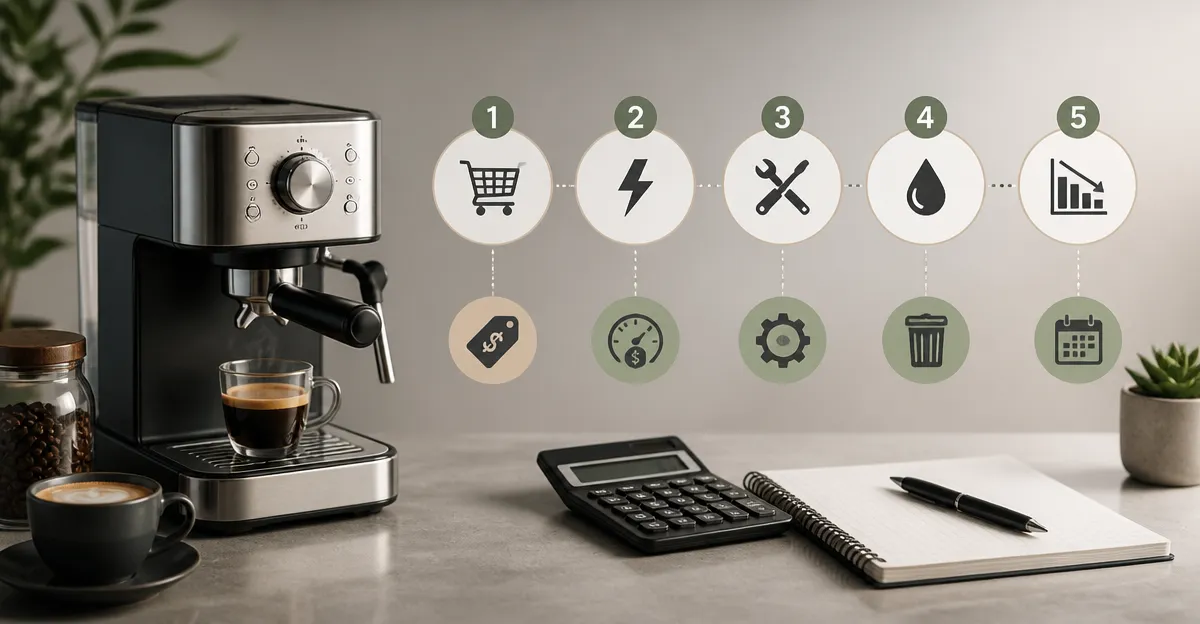
How to Calculate the Total Cost of Ownership for a Compact Espresso Machine — Step‑by‑Step TCO Calculator Guide
Introduction
One often assumes that buying a compact espresso machine is a simple expense limited to the purchase price. In reality, the total cost of ownership (TCO) includes energy consumption, routine maintenance, consumables and depreciation over the machine’s useful life. This guide explains how to quantify each component so that readers can make an informed financial decision. By following the systematic approach, one will be able to compare models objectively and select the best value for personal or professional use.
What You'll Need
- A spreadsheet program or a paper ledger for recording numbers.
- Access to the product pages of the espresso machines listed below.
- Basic knowledge of electricity rates in your region (kilowatt‑hour cost).
- Estimated usage pattern (cups per day, brewing frequency).
The products referenced in this guide are genuine tools that simplify data collection and provide reliable performance. Their specifications are taken directly from Amazon listings and include price, rating and key features.
Step 1: Define the Scope of Ownership
The first step is to outline which costs will be included in the calculation. Typical categories are initial purchase price, shipping, optional accessories, electricity usage, cleaning supplies, replacement parts and the expected resale or disposal value. One should also decide on the analysis period, commonly three to five years for home appliances. Clearly defining the scope prevents double‑counting and ensures that the final TCO reflects the true financial commitment.
Step 2: Gather Purchase Price and Shipping Costs
Collect the advertised price of the chosen espresso machine and add any shipping or handling fees. For illustration, the CASABREWS CM5418 is listed at $118.99 with a rating of 4.3 / 5 from 8,117 reviews. Its key features include a professional 20‑bar pump, built‑in pressure gauge and a compact stainless‑steel design, making it suitable for small kitchens. A premium alternative is the Breville Bambino, priced at $299.95 and rated 4 / 5 from 2,534 reviews; it offers a 54 mm portafilter, automatic steam wand and a rapid 3‑second heat‑up system. Record the final amount as “Initial Capital Expenditure.”
Step 3: Estimate Energy Consumption
Energy cost is calculated by multiplying the machine’s power rating (watts) by the average daily operating time, then converting to kilowatt‑hours (kWh). The AERCANA uses a 1450 W heating element and reaches brewing temperature in 20 seconds, which reduces overall electricity use compared with slower models. Assuming a daily usage of 30 minutes (0.5 hour), the daily consumption equals 1.45 kW × 0.5 h = 0.725 kWh. Multiply by the local electricity rate (e.g., $0.13 per kWh) to obtain the daily cost, then project over the chosen analysis period. Document this as “Operating Energy Cost.”
Step 4: Account for Maintenance, Consumables and Accessories
Regular maintenance extends the lifespan of the machine and preserves coffee quality. The atatix model emphasizes easy cleaning with a detachable water tank and drip tray; it also includes a silicone‑suction base to prevent movement during frothing. Annual expenses may include descaling solution ($15‑$20), replacement filters ($10‑$15) and occasional spare parts such as gaskets ($5‑$10). If one prefers a machine with a built‑in cleaning program, the CASABREWS CM5418 provides a simple “first use cycle” that reduces the need for additional accessories. Sum these recurring costs and label the total as “Maintenance & Consumables Cost.”
Step 5: Calculate Depreciation Over Expected Lifespan
Depreciation reflects the loss in value of the espresso machine as it ages. A common method is straight‑line depreciation, dividing the initial purchase price by the expected number of years of service. For the CASABREWS 3700, priced at $98.99, assuming a five‑year lifespan yields an annual depreciation of $19.80. The higher‑priced Breville Bambino would depreciate at $59.99 per year over the same period. Record the annual depreciation figure; this amount will be added to the yearly operating cost.
Step 6: Sum All Costs and Perform ROI Analysis
Compile the figures from steps 2 through 5 into a single table. Example calculation for a three‑year horizon using the CASABREWS CM5418 might look like this:
- Initial Purchase: $118.99
- Energy Cost (3 years): $0.13 × 0.725 kWh × 365 days × 3 ≈ $102.70
- Maintenance & Consumables (3 years): $20 × 3 = $60.00
- Depreciation (3 years): $118.99 ÷ 5 × 3 ≈ $71.40
The total cost of ownership for three years equals approximately $353.09. Compare this figure with the projected savings from brewing at home versus purchasing coffee from a café (average $4 per cup). If one drinks two cups daily, the café expense would be $2,920 over three years, yielding a net saving of $1,566.91. This quantitative insight assists the reader in deciding whether the investment aligns with personal budget goals.
Tips & Pro Tips
- Track actual electricity usage with a plug‑in power meter for the most accurate energy cost.
- Schedule descaling every 1‑2 months to avoid mineral buildup that can increase power consumption.
- Consider purchasing a reusable stainless‑steel milk frothing pitcher to reduce disposable waste and long‑term costs.
- When reselling, clean the machine thoroughly and retain all accessories; a well‑maintained unit can fetch up to 40 % of its original price.
Troubleshooting Common Issues
Overheating after frothing: Many models, including the CASABREWS line, trigger a protection mode if the boiler is still hot. Allow the machine to cool for five minutes before brewing again.
Insufficient pressure: Verify that the water tank is filled to the recommended level and that the pressure gauge reads near 20 bars. If the gauge remains low, descale the unit to remove potential blockages.
Inconsistent milk foam: Ensure the steam wand is fully purged before frothing and that the milk is cold (4‑6 °C). The AERCANA’s high‑performance wand produces dry steam, which is ideal for micro‑foam.
Conclusion
This guide has demonstrated a systematic method for calculating the total cost of ownership of a compact espresso machine. By gathering purchase data, estimating energy use, accounting for maintenance, applying depreciation and summing the results, one can obtain a clear financial picture. The example calculations illustrate how a modest initial investment can generate substantial savings compared with daily café purchases. Readers are encouraged to apply the calculator to their own usage patterns and select the machine that delivers the best value.
Products Mentioned in This Guide
Frequently Asked Questions
What factors are included in the total cost of ownership for a compact espresso machine?
TCO includes purchase price, energy consumption, routine maintenance, consumables (e.g., beans, filters) and depreciation over its useful life.
How can I estimate the energy cost of running a compact espresso machine?
Multiply the machine’s wattage by daily usage hours, then by your local kilowatt‑hour rate and the number of days in a year.
What tools do I need to calculate TCO accurately?
A spreadsheet or paper ledger, product specifications, regional electricity rates, and an estimate of daily cup volume are sufficient.
How does depreciation affect the TCO calculation?
Depreciation spreads the purchase price over the expected lifespan, reducing the annual cost portion of the machine’s price.
Can I compare different espresso models using the TCO calculator?
Yes, by entering each model’s specs and costs into the same spreadsheet, you can objectively compare their total ownership expenses.