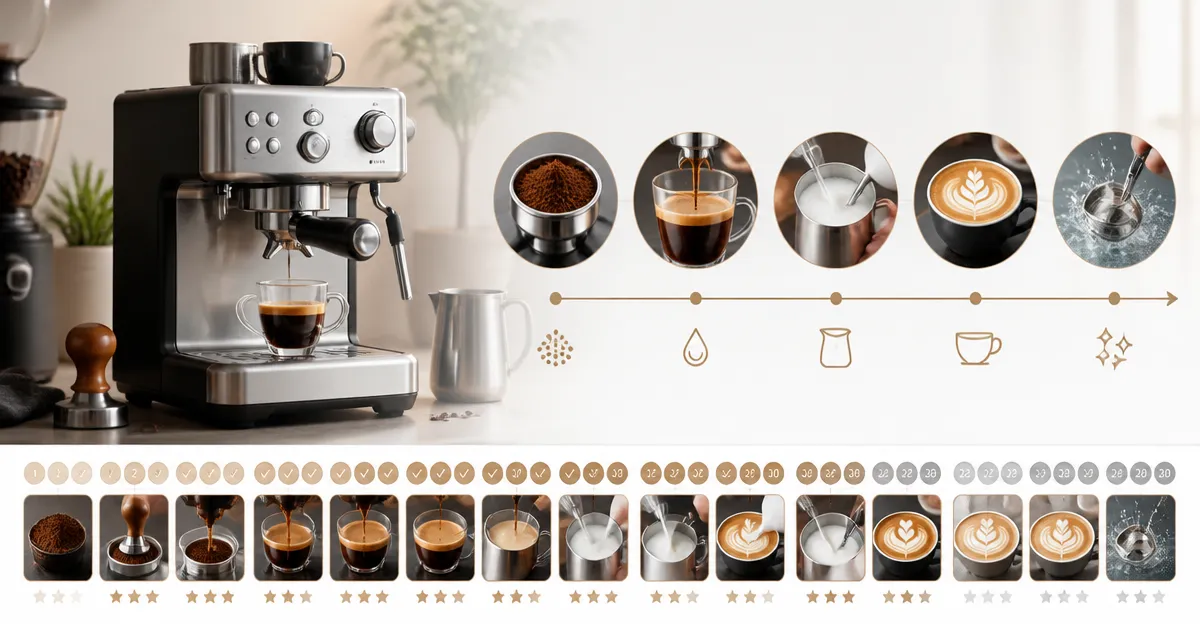
How to Master Your Compact Espresso Machine in 30 Days: A Daily Barista Practice Plan
One will learn a systematic thirty‑day program that transforms a beginner into a confident home barista. The plan emphasizes consistent practice, measurement, and incremental skill development. Mastery of extraction, milk texturing, and machine maintenance will enable one to produce café‑quality drinks on a countertop. The value lies in saving time, reducing waste, and enjoying superior coffee every morning.
What You’ll Need
- A compact espresso machine such as the Gevi 20‑Bar Compact Espresso Machine, the Mecity 20‑Bar Touchscreen Espresso Machine, or the XIXUBX 20‑Bar PID Espresso Machine.
- Fresh coffee beans, preferably single‑origin, roasted within the past three weeks.
- A burr grinder capable of 0.2 mm adjustments.
- A digital scale accurate to 0.1 g.
- A tamper, a milk frothing pitcher, and a thermometer.
- Cleaning supplies: a brush, descaling solution, and microfiber cloth.
Step 1 – Days 1‑5: Familiarize with the Machine
One should begin by reading the user manual and locating each control on the chosen espresso machine. During the first five days, the objective is to understand the pump pressure gauge, the steam wand, and the hot‑water function. For machines such as the Gevi model, the 20‑bar pump and pressure gauge provide visual feedback that aids in learning proper extraction pressure. The Gevi machine is priced at $126.99, carries a rating of 4.4 out of 5 stars from 3,028 reviews, and includes a removable water tank and milk frother, making it an all‑in‑one solution for beginners.
One should perform a series of short test brews using only water to observe how quickly the machine reaches temperature. The pre‑infusion feature on the Gevi and the touchscreen selection on the Mecity model allow one to program a brief soak before full pressure is applied, which stabilizes the coffee puck. The Mecity machine costs $129.99, enjoys a rating of 4.8 out of 5 stars from 33 reviews, and offers one‑touch beverage selection via an intuitive touchscreen.
During this period, one also practices steaming milk without coffee. The powerful steam wand on each device creates microfoam within seconds; the Gevi’s removable froth nozzle simplifies cleaning, while the Mecity’s adjustable wand provides fine control over steam pressure. By the end of day five, one will have identified the optimal steam temperature for silky foam.
Step 2 – Days 6‑10: Grind, Dose, and Tamp Consistently
Accurate grinding is the foundation of extraction quality. One should set the burr grinder to produce a particle size that resembles fine sand; a typical dose for a double shot is 18 g. Using a digital scale, one measures the dose before each brew to ensure repeatability. The XIXUBX machine, priced at $80.99 with a rating of 4.5 out of 5 stars from 574 reviews, includes a built‑in PID temperature controller that maintains stable brewing temperature, which reduces the need for frequent temperature adjustments when the grind size changes.
One must distribute the grounds evenly in the portafilter and tamp with a pressure of approximately 30 lb. The consistent pressure creates a uniform puck that resists channeling. The XIXUBX’s compact vertical design fits small kitchens, and its noise‑reduction features allow one to practice tamping without disturbing others.
After tamping, one engages the single‑button brewing function on the XIXUBX. The machine delivers a 22‑30 second extraction, which serves as a baseline for future adjustments. Recording the extraction time, weight of the output, and taste notes in a journal will help one track progress over the thirty‑day period.
Step 3 – Days 11‑15: Refine Extraction Timing and Pressure
One now focuses on the relationship between pressure, flow rate, and flavor balance. The Gevi’s pressure gauge allows one to observe when the pump reaches the full 20‑bar level. By adjusting the grind finer, one can increase resistance, causing the pressure to rise more slowly and extending the extraction time. Conversely, a coarser grind reduces resistance and shortens the shot.
One should aim for a total brew weight of 36 g for a double shot, which yields a 1:2 brew ratio. If the shot finishes before 30 seconds, one may need to grind finer; if it exceeds 35 seconds, a coarser setting is advisable. The Mecity’s touchscreen displays real‑time extraction time, enabling one to stop the brew at the desired moment without manual intervention.
During these days, one experiments with pre‑infusion durations of 2‑4 seconds on the Gevi and the Mecity models. Pre‑infusion allows the coffee bed to become fully saturated before full pressure is applied, reducing channeling and improving body. Documenting the taste differences will reinforce the learning process.
Step 4 – Days 16‑20: Master Milk Frothing Techniques
One now dedicates practice to creating microfoam suitable for latte art. The steam wand on all three machines produces a powerful jet of steam; however, the Gevi’s frothing nozzle is removable, which simplifies cleaning after repeated use. One should fill a stainless‑steel pitcher with cold milk to one‑third of its volume, insert the wand just below the surface, and open steam fully.
One must listen for a gentle hissing sound, indicating proper aeration. The milk should reach 140 °F (60 °C), which can be verified with a thermometer. The XIXUBX’s low‑vibration design reduces noise, allowing one to focus on the visual cues of the milk swirling into a glossy vortex.
After achieving a smooth, glossy texture, one practices pouring techniques: start with a steady stream, then gently shake the pitcher to create a rosette pattern. Consistent practice over five days will enable one to produce latte art comparable to café standards.
Step 5 – Days 21‑25: Create Advanced Drinks
One expands the repertoire by combining espresso with hot water, milk, or ice. The Mecity’s one‑touch selection includes Americano, over‑ice coffee, and hot water, which streamlines the preparation of layered beverages. For an iced latte, one pulls a double shot, pours it over a glass of ice, and adds freshly frothed milk.
One also experiments with flavor additions such as vanilla syrup or cocoa powder, noting how the crema interacts with each additive. The Gevi’s hot‑water function allows one to prepare tea or instant soups, demonstrating the machine’s versatility beyond coffee.
During this phase, one should record the proportion of espresso to water or milk for each drink, ensuring repeatability. The goal is to develop a personal menu of at least five signature drinks by the end of day twenty‑five.
Step 6 – Days 26‑30: Consistency, Maintenance, and Review
One finalizes the thirty‑day program by establishing a maintenance routine that preserves machine performance. The Gevi and Mecity models recommend weekly descaling using a citric‑based solution; the XIXUBX’s detachable accessories simplify the cleaning of the group head and steam wand. One should backflush the machine with blind filter punches after each cleaning cycle.
One also reviews the journal entries from the previous weeks, identifying patterns in grind size, dose, and extraction time that produced the best flavor. Adjustments are made to lock in the optimal settings, and a final blind taste test is conducted to confirm consistency.
By the conclusion of day thirty, one will possess the confidence to operate any compact espresso machine, produce balanced espresso shots, texture milk to professional standards, and maintain the equipment for long‑term use.
Tips & Pro Tips
- Always use fresh, filtered water; mineral content influences extraction and machine longevity.
- Store beans in an airtight container away from light to preserve aromatics.
- When steaming milk, keep the pitcher tilted slightly to create a whirlpool; this prevents large bubbles.
- For consistent temperature, allow the machine to fully heat for at least five minutes before the first brew each day.
- Record every variable—bean origin, grind setting, dose, temperature—to build a data set that guides future adjustments.
Conclusion
One has now followed a structured thirty‑day plan that covers machine familiarization, grind and dose precision, extraction timing, milk texturing, advanced drink creation, and diligent maintenance. The systematic approach ensures that each skill builds upon the previous one, leading to reliable, café‑quality results. Continued practice beyond the thirty days will further refine one’s palate and technique, turning the compact espresso machine into a trusted daily companion.
Products Mentioned in This Guide
Frequently Asked Questions
What is the purpose of the 30‑day barista practice plan?
It provides a structured, daily routine to build extraction, milk texturing, and maintenance skills so beginners become confident home baristas.
Which compact espresso machines are recommended for the plan?
The guide suggests the Gevi 20‑Bar Compact, Mecity 20‑Bar Touchscreen, or XIXUBX 20‑Bar PID models.
Why are fresh, single‑origin beans important?
Fresh beans (roasted within three weeks) preserve flavor complexity and ensure consistent extraction results.
What equipment is essential besides the espresso machine?
A burr grinder with 0.2 mm adjustments and a digital scale accurate to 0.1 g are required for precise dosing.
How does daily practice reduce waste and save time?
Consistent measurement and incremental skill improvements minimize trial‑and‑error, leading to fewer bad shots and faster preparation.