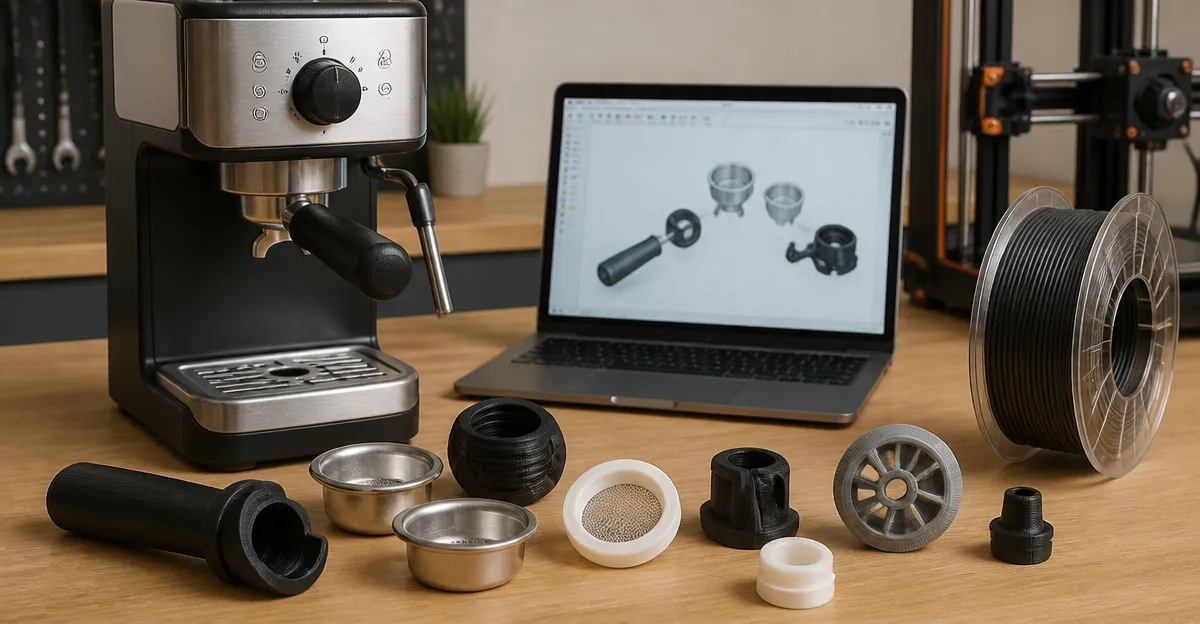
DIY Guide: 3D-Printed Replacement Parts for Compact Espresso Machines
Introduction
The modern home barista often faces the dilemma of broken or missing espresso‑machine components. Rather than discarding a beloved compact machine, a 3D‑printed replacement part can restore functionality at a fraction of the cost. This guide explains the essential background, walks through design strategies, and recommends proven products that complement a DIY workflow. Readers will learn how to assess their machine, choose the right material, and install printed parts safely.
By the end of this article, one will be able to evaluate whether a printed filter basket, portafilter handle, or other accessory is appropriate, and will have a clear roadmap for sourcing reliable replacement components.
Background and Context
Compact espresso machines typically use 51 mm portafilter baskets and handles. These dimensions have become a de‑facto standard for semi‑automatic models, allowing interchangeable parts across brands. The most common failure points are stainless‑steel filter baskets that become warped and plastic handles that crack under repeated torque.
3D printing offers two primary advantages: rapid prototyping and the ability to produce custom geometries that are difficult to machine. However, the technology also introduces challenges such as material suitability for high temperature and pressure, and the need for precise tolerances to avoid leaks.
Before embarking on a print, it is essential to understand the operating pressures of a typical compact machine (8–15 bar) and the regulatory expectations for food‑safe materials. Selecting a filament that can withstand repeated heating cycles while remaining non‑porous is critical for maintaining coffee quality.
Designing and Printing Core Components
When designing a replacement part, start with accurate measurements of the original component. Use a digital caliper to record diameter, depth, and flange thickness. CAD software such as Fusion 360 or FreeCAD allows you to model the part with the required tolerances (usually ±0.1 mm for a snug fit).
For filter baskets, a dual‑wall pressurized design mimics the commercial products that improve crema and reduce bitterness. The inner wall should feature an ultra‑fine mesh pattern, while the outer wall provides structural rigidity. A popular filament choice is food‑grade PETG, which offers heat resistance up to 80 °C and excellent chemical inertness.
Handles benefit from a combination of a rigid core (PLA or PETG) and a rubberized grip insert. The three‑ear flange design, as seen in many commercial handles, distributes torque evenly and prevents the basket from slipping during extraction.
After printing, post‑process the part by sanding any rough edges, cleaning with warm soapy water, and optionally applying a food‑safe epoxy sealant to improve water resistance.
Recommended Commercial Products
While 3D printing can address many failures, certain components perform better when sourced from established manufacturers. The following products have received strong user feedback and can serve as benchmarks or direct replacements.
- MBAIYO 51mm Espresso Filter Basket Set – A stainless‑steel, pressurized dual‑wall basket available in single‑ and double‑cup capacities. Rated 4.2/5 from 47 reviews, it costs $9.89 and includes two baskets (8 g and 16 g). The ultra‑fine screen promotes even extraction and reduces bitterness.
- BuleVina 51mm Portafilter Handle – Made from a plastic handle and alloy head, this handle features three ear flaps for secure grip. Users praise its lightweight construction and leak‑free performance; rating is 4/5 from 140 reviews, priced at $18.99.
- BuleVina 3‑Ear Portafilter Handle – Designed for a wide range of commercial and home machines, this handle combines a plastic grip with a stainless‑steel head. It carries a 4.2/5 rating from 80 reviews and costs $19.95.
- MBAIYO 51mm Espresso Filter Basket Set (Double Cup) – Similar to the first MBAIYO set but focused on the double‑cup version. It is rated 4.4/5 from 62 reviews and priced at $9.68.
- Agatige 51mm Double Espresso Filter Basket – A pressurized stainless‑steel basket with a single‑hole bottom, ideal for machines that lack sufficient pressure for crema. It enjoys a 4.4/5 rating from 1,109 reviews and costs $10.59.
These items can be used directly, or their dimensions can inform the CAD models you create for 3D printing. For example, the pressurized dual‑wall geometry of the MBAIYO baskets provides a reliable template for a printable version.
Comparison and Selection Guide
| Feature | MBAIYO 51mm Set | BuleVina 51mm Handle | BuleVina 3‑Ear Handle | Agatige Double Basket |
|---|---|---|---|---|
| Material | Stainless Steel | Plastic + Alloy | Plastic + Stainless Steel | Stainless Steel |
| Pressurized Design | Yes (dual‑wall) | No | No | Yes (single‑hole pressurized) |
| Capacity | 1 cup / 2 cup | Handle only | Handle only | Double cup |
| Rating | 4.2/5 | 4/5 | 4.2/5 | 4.4/5 |
| Price | $9.89 | $18.99 | $19.95 | $10.59 |
When choosing a replacement, consider the following criteria:
- Compatibility: Verify that the component matches the 51 mm portafilter standard of your machine.
- Pressurization: Pressurized baskets (MBAIYO, Agatige) are preferable for machines with lower pump pressure, as they aid crema formation.
- Durability: Stainless‑steel baskets outlast plastic equivalents, especially under frequent cleaning cycles.
- Ergonomics: Handles with three‑ear flaps (both BuleVina models) reduce torque strain and prevent leakage.
- Cost: For a budget‑conscious build, the MBAIYO double‑cup set offers the best price‑to‑performance ratio.
Best Practices & Tips for 3D‑Printed Parts
Even with high‑quality commercial components, many enthusiasts still prefer to print spare parts. Follow these guidelines to ensure safety and performance:
- Material Selection: Use PETG or nylon for parts exposed to hot water. Avoid standard PLA for baskets, as it softens above 60 °C.
- Layer Height and Infill: Print baskets at 0.1 mm layer height with 100 % infill to achieve the necessary rigidity. Handles can use 0.2 mm layers and 50 % infill for a lighter feel.
- Post‑Processing: Sand the interior of the basket to eliminate micro‑grooves that could trap coffee oils. Seal with a food‑grade epoxy if the filament is porous.
- Testing for Leaks: After installation, run a short water‑only extraction. Observe any drips around the flange; if present, sand the contact surfaces and re‑test.
- Documentation: Keep a log of filament batch numbers, print settings, and performance outcomes. This information simplifies future troubleshooting.
Frequently Asked Questions
- Can I print a filter basket with a standard desktop printer?
- Yes, provided you use a high‑temperature filament such as PETG and maintain tight dimensional tolerances. Expect a learning curve for achieving a leak‑free seal.
- Do 3D‑printed handles affect the machine’s warranty?
- Replacing the original handle with a printed one typically voids the warranty for that component, though the rest of the machine remains covered.
- How often should I replace a stainless‑steel basket?
- With proper cleaning, a stainless‑steel basket can last several years. Replace only when you notice warping, rust, or persistent channeling.
- Is food‑grade PETG truly safe for espresso extraction?
- Food‑grade PETG complies with FDA regulations for food contact. It is safe for short‑term exposure to hot water, making it suitable for espresso baskets.
- What is the advantage of a pressurized basket over a non‑pressurized one?
- Pressurized baskets create a higher localized pressure, forcing water through fine grounds even when the machine’s pump pressure is modest. This results in richer crema and reduced bitterness.
- Can I use the same handle on machines with different portafilter sizes? dd>Handles designed for 51 mm baskets will not fit larger diameters such as 58 mm. Verify the flange diameter before purchase.
Conclusion
3D printing empowers espresso enthusiasts to extend the life of compact machines by fabricating reliable replacement parts. By understanding material constraints, adhering to precise design tolerances, and leveraging proven commercial components as references, one can achieve consistent extraction quality without excessive expense. Whether you choose to print a pressurized basket, replace a cracked handle, or simply keep a spare set of stainless‑steel filters, the strategies outlined herein provide a solid foundation for sustainable coffee craftsmanship.
Products Featured in This Guide
MBAIYO 51mm Espresso Filter Basket Set
Price: $9.89 | Rating: 4.2/5 (47 reviews)
Featured for its pressurized dual‑wall stainless‑steel construction, providing a benchmark design for printable baskets.
BuleVina 51mm Portafilter Handle
Price: $18.99 | Rating: 4/5 (140 reviews)
Featured for its lightweight plastic‑alloy construction and three‑ear flange that ensures secure attachment.
BuleVina 3-Ear Portafilter Handle
Price: $19.95 | Rating: 4.2/5 (80 reviews)
Featured for its ergonomic design and compatibility with a broad range of commercial‑grade machines.
MBAIYO 51mm Espresso Filter Basket Set (Double Cup)
Price: $9.68 | Rating: 4.4/5 (62 reviews)
Featured for its higher rating and focus on the double‑cup capacity, useful for larger espresso servings.
Agatige 51mm Double Espresso Filter Basket
Price: $10.59 | Rating: 4.4/5 (1,109 reviews)
Featured for its single‑hole pressurized design, which excels on machines with lower pump pressure.